Weisheit, die in Gott verwurzelt ist
WENN WEISHEIT NACH WEISHEIT SUCHT
Wenn wir in der Bibel über Weisheit reden, kommt meistens ein Name auf – König Salomo, der Typ, der Gott nicht um Reichtum oder Macht gebeten hat, sondern um Verständnis. Die Bibel sagt uns, dass seine Weisheit die aller Könige der Welt übertraf.
Aber in Salomos Geschichte gibt’s noch eine andere bemerkenswerte Person – die Königin von Saba. Sie war nicht nur eine Besucherin, die Geschenke mitbrachte. Sie war selbst eine Herrscherin, die für ihre Klugheit, Intelligenz und ihr Urteilsvermögen bekannt war. Die Bibel stellt sie nicht als Untergebene dar, sondern als eine potenzielle Gleichgestellte, eine Frau, die in der Lage war, den weisesten König zu prüfen, den Israel je gekannt hatte.
Ihre Geschichte lehrt uns, dass wahre Weisheit nicht an Geschlecht, Nationalität oder Thron gebunden ist, sondern von denen erkannt wird, die sie demütig suchen.
Eine Frau, die für ihre Weisheit bekannt war
In 1. Könige 10,1 heißt es: „Als die Königin von Saba vom Ruhm Salomos hörte, der mit dem Namen des Herrn verbunden war, kam sie, um ihn mit schwierigen Fragen auf die Probe zu stellen.“
Beachte, was sie zu Salomo zog.
Es war nicht sein Palast.
Es war nicht sein Reichtum.
Es war seine Weisheit, die mit dem Namen des Herrn verbunden war.
Die Königin von Saba regierte ein blühendes Königreich. Sie beherrschte Handelswege, Reichtum und Einfluss. Doch trotz ihrer Macht erkannte sie etwas, das sie nicht vollständig besaß – göttliche Weisheit.
Wahre Weisheit beginnt, wenn wir zugeben, dass wir nicht alles wissen.
Sie kam mit „schwierigen Fragen“. Nicht mit Small Talk. Nicht mit Schmeicheleien. Sie kam mit den tiefgründigsten Fragen zu Führung, Leben, Gerechtigkeit und Sinn. Und die Schrift sagt, dass Salomo alle ihre Fragen beantwortete.
Weisheit begrüßt Fragen.
Weisheit fühlt sich durch Fragen nicht bedroht.
Weisheit strahlt am hellsten, wenn sie auf den Prüfstand gestellt wird.
Weisheit erkennt Weisheit
In 1 Könige 10,6–7 ist ihre Antwort festgehalten:
„Es war eine wahre Nachricht, die ich gehört habe … doch ich glaubte den Worten nicht, bis ich kam und es mit eigenen Augen sah; und siehe, mir war nicht einmal die Hälfte davon erzählt worden.“
Das ist tiefgründig. Eine weise Frau erkennt Weisheit, wenn sie ihr begegnet. Sie beneidete Salomo nicht. Sie konkurrierte nicht mit ihm. Sie erkannte das Außergewöhnliche, als sie es sah.
Das ist selten in einer Welt, die von Stolz getrieben ist.
Die Königin von Saba zeigt uns, dass Weisheit die Weisheit anderer feiert. Sie schmälert sich nicht selbst, indem sie andere ehrt. Stattdessen wächst sie.
Ihre Demut schwächte ihre Autorität nicht – sie stärkte sie.
Weisheit, die in Gott verwurzelt ist
Sie bewunderte nicht nur Salomos Intellekt. Sie erkannte die Quelle seiner Weisheit.
In Vers 9 heißt es:
„Gepriesen sei der Herr, dein Gott, der Gefallen an dir gefunden hat, dich auf den Thron Israels zu setzen.“
Sie führte Salomos Weisheit auf Gott selbst zurück.
Das ist der Unterschied zwischen weltlicher Intelligenz und göttlicher Weisheit. Intelligenz kann beeindrucken. Weisheit verändert. Aber nur Weisheit, die in Gott verwurzelt ist, bringt Gerechtigkeit, Frieden und Rechtschaffenheit hervor.
Salomo war nicht nur wegen seiner Bücher oder Erfahrungen weise, sondern weil er mit dem Geber der Weisheit verbunden war.
Und die Königin von Saba erkannte, dass wahre Weisheit uns immer zur Anbetung führt.
Jesus hebt ihr Beispiel hervor
Jahrhunderte später sprach Jesus selbst von dieser Frau.
In Matthäus 12,42 heißt es:
„Die Königin des Südens wird beim Gericht auferstehen … denn sie kam vom Ende der Erde, um die Weisheit Salomos zu hören; und siehe, hier ist einer, der größer ist als Salomo.“
Jesus ehrt sie als Beispiel für geistliche Hungersnot.
Sie reiste weit, um Weisheit zu suchen.
Sie überschritt Grenzen, um die Wahrheit zu finden.
Sie scheute keine Mühen, um Gottes Stimme zu hören.
Und Jesus stellt ihre Begierde der spirituellen Gleichgültigkeit seiner eigenen Generation gegenüber.
Die Königin von Saba hatte keine Heilige Schrift, keine Propheten und keine Wunder – dennoch suchte sie leidenschaftlich nach Weisheit. Wie viel mehr Verantwortung haben wir, die wir Christus selbst haben?
Weisheit sucht die Wahrheit, nicht Bequemlichkeit.
Die Königin blieb nicht dort, wo sie zufrieden war. Sie strebte nach tieferem Verständnis.
Weisheit ist demütig genug, um zu lernen.
Trotz ihrer Macht wurde sie eine Schülerin.
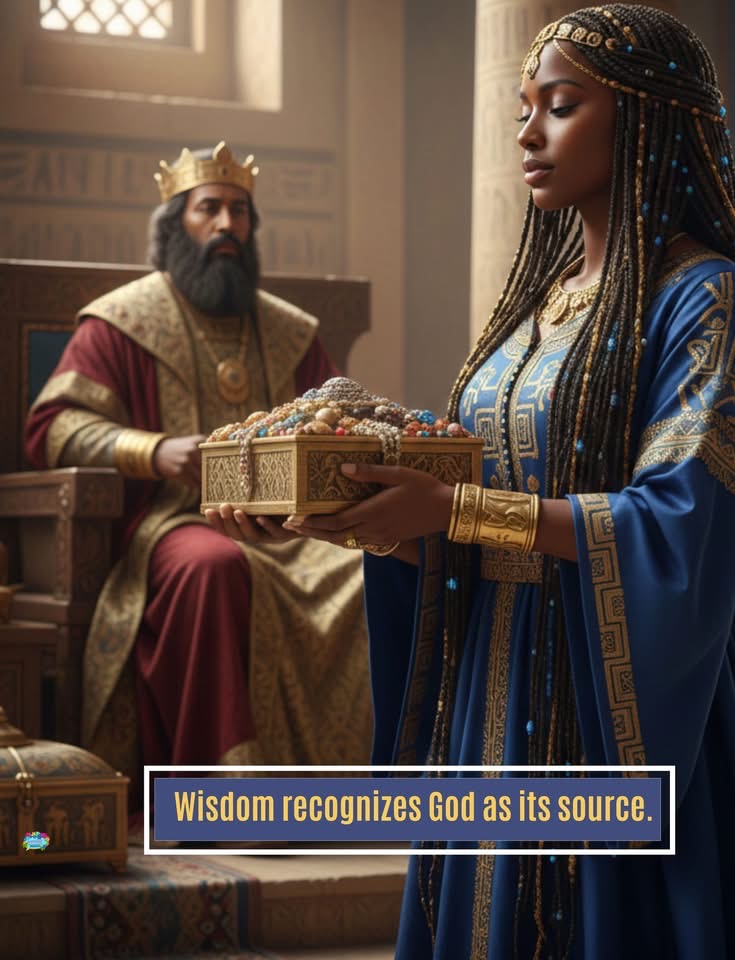
Weisheit erkennt Gott als ihre Quelle an.
Sie lobte den Herrn, nicht nur den König.
Weisheit reagiert mit Taten.
Sie brachte Geschenke mit, erwies Ehre und kehrte verwandelt zurück.
Das Treffen zwischen Salomo und der Königin von Saba war kein Wettstreit – es war ein Gespräch zwischen Weisheit und Weisheit.
Sie erinnert uns daran, dass Gott zu jeder Zeit und an jedem Ort weise Führer hervorbringt und dass wahre Größe nicht in Titeln zu finden ist, sondern im Streben nach göttlichem Verständnis.
Christus steht vor uns als einer, der größer ist als Salomo. Die Frage ist nicht, ob Weisheit verfügbar ist, sondern ob wir, wie die Königin von Saba, uns erheben, sie suchen und darauf reagieren werden.
Mögen wir Menschen sein, die jede Entfernung zurücklegen, jede Frage stellen und jeden Stolz beiseite legen – nur um die Weisheit Gottes zu hören.
This entry was posted in 1. Könige, 2. Samuel, Fundstücke, Gemeinsam Bibellesen, Matthäus and tagged 1. Könige 10, Königin von Saba, Matthäus 12 by Jule with 1 commentComments
Schreibe einen Kommentar
Du musst angemeldet sein, um einen Kommentar abzugeben.
WHEN WISDOM SEEKS WISDOM
When we speak of wisdom in the Bible, one name usually dominates the conversation—King Solomon, the man who asked God not for riches or power, but for understanding. Scripture tells us that his wisdom surpassed all the kings of the earth.
Yet tucked within Solomon’s story is another remarkable figure—the Queen of Sheba. She was not merely a visitor bringing gifts. She was a ruler in her own right, renowned for her cleverness, intelligence, and discernment. Scripture presents her not as a subordinate, but as a potential equal, a woman capable of testing the wisest king Israel had ever known.
Her story teaches us that true wisdom is not confined to gender, nationality, or throne—but is recognized by those who humbly seek it.
A Woman Known for Wisdom
1 Kings 10:1 says, “When the queen of Sheba heard of the fame of Solomon concerning the name of the Lord, she came to prove him with hard questions.”
Notice what drew her to Solomon.
It was not his palace.
It was not his wealth.
It was his wisdom connected to the name of the Lord.
The Queen of Sheba ruled a prosperous kingdom. She commanded trade routes, wealth, and influence. Yet despite her power, she recognized something she did not fully possess—divine wisdom.
True wisdom begins when we admit we do not know everything.
She came with “hard questions.” Not small talk. Not flattery. She came with the deepest inquiries of leadership, life, justice, and meaning. And Scripture says Solomon answered all her questions.
Wisdom welcomes inquiry.
Wisdom is not threatened by questions.
Wisdom shines brightest under examination.
Wisdom Recognizes Wisdom
1 Kings 10:6–7 records her response:
“It was a true report that I heard… howbeit I believed not the words, until I came, and mine eyes had seen it: and behold, the half was not told me.”
This is profound. A wise woman recognizes wisdom when she encounters it. She did not envy Solomon. She did not compete with him. She acknowledged excellence when she saw it.
This is rare in a world driven by pride.
The Queen of Sheba shows us that wisdom celebrates wisdom in others. It does not diminish itself by honoring another. Instead, it grows.
Her humility did not weaken her authority—it strengthened it.
Wisdom That Is Rooted in God
She did not merely admire Solomon’s intellect. She recognized the source of his wisdom.
Verse 9 says:
“Blessed be the Lord thy God, which delighted in thee, to set thee on the throne of Israel.”
She traced Solomon’s wisdom back to God Himself.
This is the dividing line between worldly intelligence and godly wisdom. Intelligence can impress. Wisdom transforms. But only wisdom rooted in God produces justice, peace, and righteousness.
Solomon was wise not because of books or experience alone, but because he was connected to the Giver of wisdom.
And the Queen of Sheba recognized that true wisdom always leads us to worship.
Jesus Elevates Her Example
Centuries later, Jesus Himself spoke of this woman.
Matthew 12:42 says:
“The queen of the south shall rise up in the judgment… for she came from the uttermost parts of the earth to hear the wisdom of Solomon; and behold, a greater than Solomon is here.”
Jesus honors her as an example of spiritual hunger.
She traveled far to seek wisdom.
She crossed boundaries for truth.
She spared no effort to hear God’s voice.
And Jesus contrasts her eagerness with the spiritual indifference of His own generation.
The Queen of Sheba did not have Scripture, prophets, or miracles—yet she sought wisdom passionately. How much more are we responsible, who have Christ Himself?
Wisdom seeks truth, not comfort.
The Queen did not stay where she was satisfied. She pursued deeper understanding.
Wisdom is humble enough to learn.
Despite her power, she became a student.
Wisdom recognizes God as its source.
She praised the Lord, not merely the king.
Wisdom responds with action.
She brought gifts, offered honor, and returned transformed.
The meeting of Solomon and the Queen of Sheba was not a contest—it was a conversation between wisdom and wisdom.
She reminds us that God raises wise leaders in every place and time, and that true greatness is found not in titles, but in the pursuit of divine understanding.
Christ stands before us as One greater than Solomon. The question is not whether wisdom is available—but whether we will, like the Queen of Sheba, rise up, seek it, and respond.
May we be people who travel any distance, ask any question, and lay aside any pride—just to hear the wisdom of God.
(Note: Generated with assistance from ChatGPT)