diejenigen, die bereit sind, geläutert zu werden
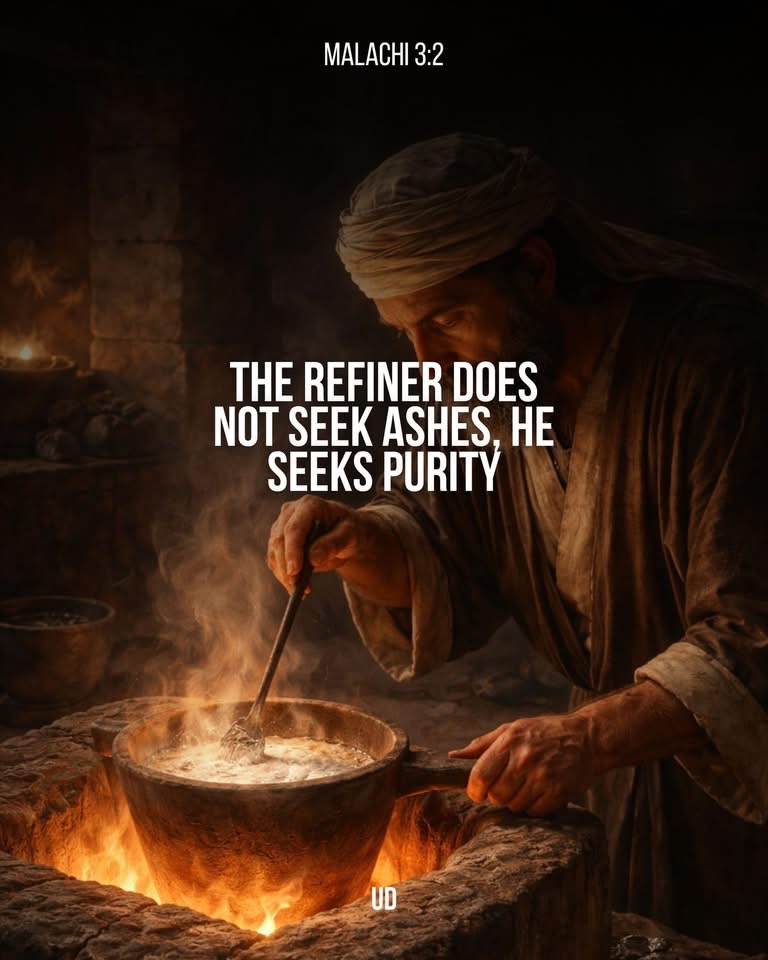
„Wer kann den Tag seines Kommens ertragen,
und wer kann bestehen, wenn er erscheint?“
Maleachi 3,2
Die Frage selbst hat Gewicht.
Sie geht davon aus, dass das Kommen des Herrn
keine sanfte Unterbrechung des normalen Lebens ist.
Es ist nicht dekorativ oder nur beruhigend.
Es ist ein Ereignis, das diejenigen, die es erleben, unter Druck setzt,
eine Ankunft, die eher entlarvt als schmückt.
Der Prophet greift zu einem Bild, das seine Zuhörer
sicherlich tief verstanden haben.
Er sagte, dass der Herr wie das Feuer eines Schmelzers sein wird.
Zum Kontext: In der Antike
war das Schmelzen ein kunstvolles und bewusstes Handwerk.
Feuer wurde nicht leichtfertig eingesetzt.
Gold und Silber wurden nicht deshalb erhitzt,
weil sie entbehrlich waren,
sondern weil sie kostbar waren.
Die Aufgabe des Veredlers bestand nicht darin,
das Metall zu zerstören, sondern es zu seinem wahren Selbst zu machen.
Zu wenig Hitze brachte nichts.
Zu viel Hitze ruinierte das, was nicht ersetzt werden konnte.
Das Feuer musste dosiert, aufrechterhalten und sorgfältig beobachtet werden.
Während das Metall erhitzt wurde, stiegen Verunreinigungen,
die sich im Laufe der Zeit darin angesammelt hatten, an die Oberfläche.
Was nicht dazugehörte, trennte sich von dem, was dazugehörte.
Das Feuer schuf die Verunreinigungen nicht, es brachte sie zum Vorschein.
Was lange Zeit verborgen war, wurde
unter dem Druck der Hitze sichtbar.
Beim Veredeln ging es also nie um Ablehnung.
Es ging um die Unterscheidung zwischen dem,
was echt war, und dem, was nicht bleiben konnte.
Maleachi sagt ganz genau, wo diese Veredelungsarbeit beginnt.
„Er wird die Söhne Levis reinigen“ (Maleachi 3,3).
Das Feuer beginnt nicht bei den Völkern
oder bei denen, die eindeutig außerhalb des Bundes stehen.
Es beginnt bei denen, die dem Altar am nächsten sind,
denen, die mit der Anbetung,
der Unterweisung und der Vertretung betraut sind.
Im Leben Israels standen die Priester
den heiligen Dingen Gottes am nächsten.
Wenn die Anbetung wiederhergestellt werden sollte,
konnte dies nicht geschehen, ohne sie einzubeziehen.
Die Anbetung kann nicht erneuert werden, wenn die Anbeter
selbst unberührt bleiben.
Diese Läuterung ist ein Gericht, aber keine Verlassenheit.
Es ist ein Gericht, das auf Wiederherstellung abzielt.
Maleachi sagt, der Zweck dieser Reinigung sei,
„damit sie Opfer in Gerechtigkeit darbringen können“.
Das Feuer ist kein Selbstzweck.
Schmerz ist nicht das Ziel. Reinheit ist es.
Die Enthüllung dient nicht der
Demütigung, sondern der Heilung.
Das Feuer der Läuterung existiert, weil
Gott möchte, dass die Anbetung wieder echt ist,
nicht nur wie eine Routine oder Pflicht.
Zu Malachis Zeiten hatte sich das Volk
an eine verminderte Ehrfurcht gewöhnt.
Opfer wurden immer noch dargebracht,
aber ohne Ehrerbietung.
Gottes Name wurde ausgesprochen, aber ohne Gewicht.
Die Formen der Anbetung blieben bestehen,
aber ihr Kern war verblasst.
Das Feuer des Läuterers konfrontiert diese Art von Glauben
nicht, indem es den Altar entfernt, sondern indem es ihn reinigt.
Nicht, indem es die Anbetung beendet, sondern indem es sie wieder wahrhaftig macht.
Zu Beginn der Evangelien
nimmt diese Verheißung Gestalt an.
Der Messias kommt nicht
umgeben von sichtbaren Flammen,
aber seine Gegenwart brennt genauso tief.
Er deckt Motive auf, erschüttert bequeme Religiosität
und konfrontiert Heuchelei, die gelernt hat,
sich hinter Frömmigkeit zu verstecken.
Gleichzeitig heilt, stellt wieder her und vergibt er.
Sein Feuer verzehrt nicht die Menschen,
sondern das, was sie von Gott fernhält.
Die Läuterungsarbeit ist oft unangenehm,
weil sie nicht beim Verhalten Halt macht.
Sie reicht bis ins Herz. Sie hält an.
Sie drängt. Sie weigert sich, etwas zu überstürzen,
was ganz gemacht werden muss.
Das Bild von Maleachi erinnert uns daran, dass
Gottes Heiligkeit nicht im Widerspruch zu seiner Barmherzigkeit steht.
Dasselbe Feuer, das Unreinheit offenbart,
ist das Feuer, das das Wahre bewahrt.
Der Herr läutert, weil er beabsichtigt,
unter seinem Volk zu wohnen.
Er reinigt, weil er Nähe wünscht,
nicht Distanz.
Wenn Maleachi also fragt:
„Wer kann bestehen, wenn er erscheint?“,
lautet die Antwort nicht: diejenigen, die bereits rein sind.
Die Schrift suggeriert das niemals.
Die Antwort lautet: diejenigen, die bereit sind, geläutert zu werden.
Diejenigen, die den Händen vertrauen, die das Feuer kontrollieren.
Diejenigen, die glauben, dass das, was Gott entfernt,
nie dazu bestimmt war, zu bleiben.
Das Feuer des Läuterers zerstört den Glauben nicht.
Es bereitet ihn vor, bis das, was übrig bleibt,
in der Gegenwart eines heiligen Gottes bestehen kann.
Letztendlich findet Malachis Läuterer
seine Erfüllung in Christus.
Er ist derjenige, der sich nähert,
ohne zu zerstören, und derjenige,
der Heiligkeit trägt, ohne
die Barmherzigkeit zurückzuziehen.
In seinem Leben und Wirken
sehen wir den Läuterer am Werk,
der nicht weit vom Feuer entfernt steht,
sondern ganz in die menschliche Schwäche eintritt
und ihre Hitze selbst trägt.
Am Kreuz treffen Gericht und Barmherzigkeit aufeinander,
nicht um die Sünder aufzugeben, sondern um
wahre Anbetung wieder möglich zu machen.
Christus läutert uns nicht aus der Ferne.
Er läutert uns, indem er unter uns wohnt,
sich selbst hingibt und treu bleibt,
bis das, was vor Gott steht, nicht mehr
von Angst oder Heuchelei geprägt ist, sondern von Gnade, die rein macht.
Comments
Schreibe einen Kommentar
Du musst angemeldet sein, um einen Kommentar abzugeben.
“Who can endure the day of His coming,
and who can stand when He appears?”
Malachi 3:2
The question itself carries weight.
It assumes that the coming of the Lord
is not a gentle interruption of ordinary life.
It is not ornamental or merely reassuring.
It is an event that presses upon those who witness it,
an arrival that exposes rather than decorates.
The prophet reaches for an image his audience
would definitely have understood deeply.
He said that the Lord will be like a refiner’s fire.
For context, the ancient world,
refining was a skilled and deliberate craft.
Fire was not used recklessly.
Gold and silver were placed into heat
not because they were expendable,
but because they were precious.
The refiner’s task was not to destroy
the metal but to make it truly itself.
Too little heat accomplished nothing.
Too much heat ruined what could not be replaced.
The fire had to be measured, sustained, and carefully watched.
As the metal was heated, impurities that
had been mixed in over time and rose to the surface.
What did not belong separated itself from what did.
The fire did not create the impurity, it revealed it.
What had long been hidden becomes
visible under the pressure of heat.
So, refining, then, was never about rejection.
It was about distinction, between what
was genuine and what could not remain.
Malachi is careful to say where this refining work begins.
“He will purify the sons of Levi” (Malachi 3:3).
The fire does not start with the nations
or with those clearly outside the covenant.
It begins with those closest to the altar,
those entrusted with worship,
instruction, and representation.
In Israel’s life, the priests stood
nearest to the holy things of God.
If worship was to be restored,
it could not begin by bypassing them.
Worship cannot be renewed if the worshipers
themselves remain untouched.
This refining is judgment, but it is not abandonment.
It is a judgment aimed toward restoration.
Malachi says the purpose of this purification
is “so that they may bring offerings in righteousness.”
The fire is not an end in itself.
Pain is not the goal. Purity is.
Exposure is not meant for
humiliation but for healing.
The refining fire exists because
God intends worship to be real again,
not just as if it’s routine or duty.
By Malachi’s time, the people had grown
accustomed to diminished reverence.
Sacrifices were still offered,
but without honor.
God’s name was spoken, but without weight.
The forms of worship remained,
yet the heart of it had thinned.
The refiner’s fire confronts this kind of faith
not by removing the altar, but by cleansing it.
Not by ending worship, but by making it truthful again.
When the Gospels open,
this promise begins to take shape.
The Messiah does not arrive
surrounded by visible flames,
yet His presence burns just as deeply.
He exposes motives, unsettles comfortable religion,
and confronts hypocrisy that had
learned how to hide behind piety.
At the same time, He heals, restores, and forgives.
His fire does not consume people,
it consumes what keeps them from God.
The refining work is often uncomfortable
because it does not stop at behavior.
It reaches into the heart. It lingers.
It presses. It refuses to rush
what must be made whole.
Malachi’s image reminds us that
God’s holiness is not opposed to His mercy.
The same fire that reveals impurity
is the fire that preserves what is true.
The Lord refines because He intends
to dwell among His people.
He cleanses because He desires
nearness, not distance.
So when Malachi asks,
“Who can stand when He appears?”
the answer is not those who are already pure.
Scripture never suggests that.
The answer is those willing to be refined.
Those who trust the hands that control the fire.
Those who believe that what God removes
was never meant to remain.
The refiner’s fire does not destroy faith.
It prepares it, until what remains is able
to stand in the presence of a holy God.
Ultimately, Malachi’s refiner finds
His fulfillment in Christ.
He is the one who comes near
without destroying, and the one
who carries holiness without
withdrawing mercy.
In His life and ministry,
we see the refiner at work,
not standing far from the fire,
but entering fully into human weakness,
bearing its heat Himself.
On the cross, judgment and mercy meet,
not to abandon sinners but to make
true worship possible again.
Christ does not refine us from a distance.
He refines by dwelling among us,
by giving Himself, and by remaining faithful
until what stands before God is no longer
shaped by fear or pretense, but by grace made clean.