IM Anfang
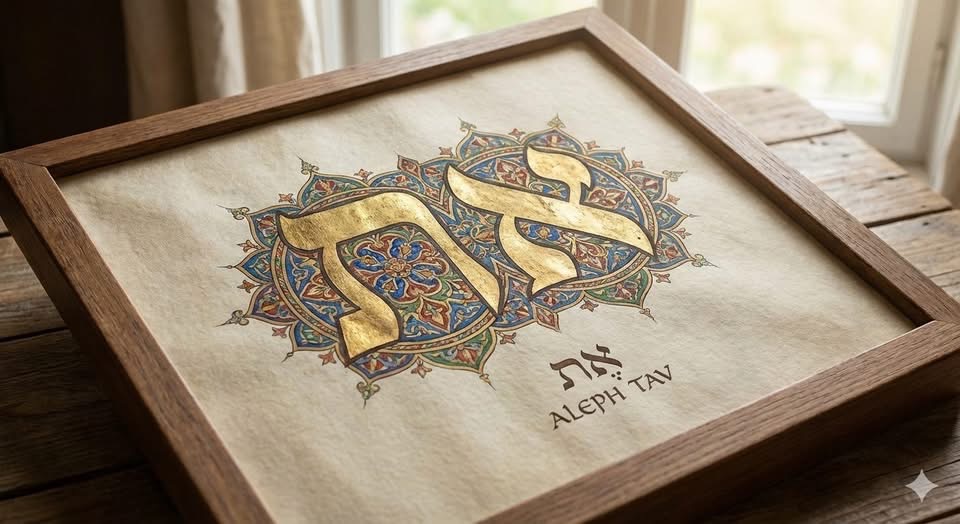
Das Unausgesprochene am Anfang – (Das ignorierte hebräische Buchstabenpaar)
„Am Anfang schuf Gott Himmel und Erde.“
Genesis 1:1
Nur … … das steht so nicht im hebräischen Text.
Im Hebräischen steht:
Das ist eigentlich gar kein Wort.
Zwei Buchstaben.
אֵת – Aבְּרֵאשִׁית בָּרָא אֱלֹהִים אֵת הַשָּׁמַיִם וְאֵת הָאָרֶץ
Bereshit bara Elohim et ha-shamayim ve’et ha’aretz.
Und genau dort – still, unübersetzt, unausgesprochen, von englischen Bibeln ignoriert – steht ein Wort
dleph-Tav.
Kein Laut.
Keine Übersetzung.
Keine Bedeutung im Englischen.
Es ist einfach nur … … da.
Zweimal.
Am Anfang von allem.
Was ist „Et”? Bevor wir darüber reden, was es bedeuten könnte, schauen wir uns mal an, was es ist.
In der hebräischen Grammatik ist et ein Direktobjektmarker. Es zeigt auf das Ding, auf das die Handlung angewendet wird.
Es lässt sich nicht übersetzen.
Es spricht nicht.
Es kündigt sich nicht an.
Es markiert einfach nur.
Das sollte dich schon mal zum Nachdenken bringen, denn Hebräisch verschwendet keine Tinte. Und die Heilige Schrift führt in Genesis 1 nichts ein, um es dann zu vergessen.
Aleph und Tav – Anfang und Ende
Schauen wir uns jetzt die Buchstaben selbst an.
Aleph (א) – erster Buchstabe des hebräischen Alphabets
Tav (ת) – letzter Buchstabe des hebräischen Alphabets
Zusammen: der Anfang und das Ende.
Kommt dir das bekannt vor?
„Ich bin das Alpha und das Omega.“ (Offenbarung 1,8)
Alpha und Omega sind griechisch.
Aleph und Tav sind hebräisch.
Gleiches Konzept. Unterschiedliches Alphabet.
Johannes hat diese Idee nicht erfunden.
Er hat sie übersetzt.
Zurück zu Genesis und dem unausgesprochenen Zeichen der Schöpfung …
„Am Anfang schuf Gott et den Himmel und et die Erde.“
Gott erschafft nicht einfach nur Dinge.
Er kennzeichnet sie.
Das et steht zwischen Gott und der Schöpfung – präsent, still, unübersetzt.
Es wird nicht ausgesprochen.
Es wird nicht beschrieben.
Es ist kein Satz.
Es ist nicht „Jesus“ buchstabiert. Es ist einfach mit Gott am Anfang.
Und plötzlich sollte Johannes 1 einen bekannt vorkommen.
„Am Anfang war das Wort, und das Wort war bei Gott, und das Wort war Gott.“
Nicht geschaffen.
Noch nicht ausgesprochen.
Nicht sichtbar.
Bei Gott … … das Wort vor den Worten.
Hier müssen wir vorsichtig sein – aber ehrlich.
Das „et“ ist kein Name.
Es wird
im Hebräischen heimlich ausgesprochen.
Aber es ist ein Zeichen der Totalität.
Ein Hinweis auf alles vom Anfang bis zum Ende. Eine stille Präsenz, eingebettet in die Grammatik der Schöpfung selbst.
Die Rabbiner haben das lange vor den Christen bemerkt. In jüdischen Kommentaren wird das „et“ manchmal so verstanden, dass es alles umfasst, was folgt – alle Details, alle Substanz, alle Realität, die in der Handlung enthalten ist.
Mit anderen Worten: Gott hat nicht nur „Himmel und Erde“ geschaffen.
Er hat alles geschaffen, was diese Worte beinhalten.
Und das Zeichen dieser Fülle?
Aleph-Tav.
Kommen wir nun vom stillen Zeichen zum gesprochenen Wort … … und schauen wir uns an, was die Schrift tut.
Das Aleph-Tav kommt über 7.000 Mal in der hebräischen Bibel vor.
Immer still.
Immer unübersetzt.
Immer präsent.
Bis …
„Ich bin das Aleph und das
Tav.“ („Ich bin das Alpha und das Omega.“ (Offenbarung 1,8))
Plötzlich spricht das stille Zeichen.
Derjenige, der vom ersten Vers an präsent war, aber unausgesprochen blieb, wird Mensch und stellt sich vor.
Das Wort wird sichtbar.
Das Zeichen wird Mensch.
Die Grammatik wird zu Fleisch und Blut.
Das ist der Thora nicht fremd.
Das ist die Thora, die ihren Höhepunkt erreicht.
Das ist keine Code-Jagd – das ist Bund.
Lass uns noch einmal klarstellen, denn das ist wichtig…
Es geht nicht darum, unter jedem Stein Jesus zu finden.
Es geht darum, zu erkennen, dass Gott Kohärenz in seine Offenbarung eingebettet hat.
Derselbe Gott, der mit Worten schuf, mit Blut einen Bund schloss, sich durch einen Namen offenbarte, die Thora schrieb und Propheten sandte…
… widerspricht sich nicht plötzlich im Neuen Testament.
Das Aleph-Tav ersetzt nicht die Thora.
Es
bewegt sich durch sie hindurch.
Das Wort hebt den Anfang – das Gesetz – nicht auf.
Es erfüllt es – füllt es bis zum vollen Ausdruck, von Aleph bis Tav.
Ein erfüllter Samen ist ein Baum. Ein erfüllter Bauplan ist das fertiggestellte Gebäude. Es ist der volle Ausdruck dessen, wofür es ursprünglich entworfen wurde.
Das sollte dich verändern, denn wenn das Aleph-Tav bei der Schöpfung da war, im Bund da war, in der Thora da war und im Messias da war…
…ist Er in alle Ewigkeit derselbe, und Sein Bund ändert sich nicht.
„Ich bin YHWH, ich ändere mich nicht“ (Maleachi 3,6)
Dann ist Gehorsam keine Option.
Buße ist nicht überflüssig.
Und Gnade ist keine Erlaubnis, sich treiben zu lassen.
Man kann nicht das Wort für sich beanspruchen und gleichzeitig die Struktur ablehnen, die Er geschaffen hat.
Man kann nicht das Tav bekommen,
wenn man das Aleph verwirft.
Das et war vor dem Licht da.
Vor der Sprache.
Vor der Sünde.
Still.
Unübersetzt.
Treue.
Und als die Zeit gekommen war,
sprach Er.
Nicht, um den Anfang auszulöschen – sondern um ihn zu seinem beabsichtigten Ende zu bringen.
Von Aleph
bis Tav.
Von Genesis
bis zur Offenbarung.
Vom Bund
bis zum erfüllten Bund.
Und wenn du Ihn dort einmal gesehen hast … … wirst du den Anfang nie wieder
auf die gleiche Weise lesen.
Comments
Schreibe einen Kommentar
Du musst angemeldet sein, um einen Kommentar abzugeben.
The Unspoken One in the Beginning – (The Ignored Hebrew Letter Pair)
“In the beginning God created the heavens and the earth.”
Genesis 1:1
Except… …that’s not actually what the Hebrew says.
The Hebrew reads:
that isn’t really a word at all.
Two letters.
אֵת – Aבְּרֵאשִׁית בָּרָא אֱלֹהִים אֵת הַשָּׁמַיִם וְאֵת הָאָרֶץ
Bereshit bara Elohim et ha-shamayim ve’et ha’aretz.
And right there – sitting quietly, untranslated, unpronounced, ignored by English Bibles – is a wor
dleph-Tav.
No sound.
No translation.
No meaning in English.
Just… …there.
Twice.
At the beginning of everything.
What Is “Et”? Let’s start with what it is, before we talk about what it might mean.
In Hebrew grammar, et is a direct-object marker. It points to the thing being acted upon.
It doesn’t translate.
It doesn’t speak.
It doesn’t announce itself.
It just… …marks.
Which already should make you pause, because Hebrew doesn’t waste ink. And Scripture doesn’t introduce something in Genesis 1 and then forget about it.
Aleph and Tav – First and Last
Now let’s look at t
he letters themselves.
Aleph (א) – first letter of the Hebrew alphabet
Tav (ת) – last letter of the Hebrew alphabet
Together: the beginning and the end.
Sound familiar?
“I am the Alpha and the Omega.” (Revelation 1:8)
Alpha and Omega are Greek.
Aleph and Tav are Hebrew.
Same concept. Different alphabet.
John didn’t invent this idea.
He translated it.
Back to Genesis, and the unspoken marker of creation…
“In the beginning, God created et the heavens and et the earth.”
God doesn’t just create things.
He marks them.
The et stands between God and creation – present, silent, untranslated.
It is not spoken.
It is not described.
not a sentence.
It is not “Jesus” spellIt is simply with God in the beginning.
And suddenly John 1 should start ringing bells.
“In the beginning was the Word, and the Word was with God, and the Word was God.”
Not created.
Not spoken yet.
Not visible.
With God… …the Word before words
Here’s where we must tread carefully – but honestly.
The et is not a name.
It is
ed secretly in Hebrew.
But it is a marker of totality.
A pointer to everything from beginning to end. A silent presence embedded in the grammar of creation itself.
The rabbis noticed this long before Christians did. In Jewish commentary, the et is sometimes understood as encompassing everything that follows – all details, all substance, all reality contained within the act.
In other words: God didn’t just create “heavens and earth.”
He created everything those words include.
And the marker of that fullness?
Aleph-Tav.
Now, let’s go from silent marker to speaking word… …watch what Scripture does.
The aleph-tav appears over 7,000 times in the Hebrew Bible.
Always silent.
Always untranslated.
Always present.
Until…
“I am the Aleph and the
Tav.” (“I am the Alpha and the Omega.” (Revelation 1:8))
Suddenly the silent marker speaks.
The One who was present from the first verse but unpronounced steps into flesh and introduces Himself.
The Word becomes visible.
The marker becomes a man.
The grammar becomes blood and bone.
This is not foreign to Torah.
This is Torah reaching its climax
This is not code-hunting – this is covenant.
Let’s be clear again, because this matters…
This is not about finding Jesus under every rock.
This is about recognizing that God embedded coherence into His revelation.
The same God who created with words, covenanted with blood, revealed Himself by a Name, wrote Torah and sent prophets…
…does not suddenly contradict Himself in the New Testament.
The aleph-tav does not replace Torah.
It
moves through it.
The Word does not abolish the beginning – the law.
He fulfills it – fills it to full expression, from aleph to tav.
A seed fulfilled is a tree. A blueprint of a building fulfilled is the final finished building. It is the full expression of what it was originally designed to be.
This should change you because if the aleph-tav was present at creation, and present in covenant, and present in Torah, and present in Messiah…
…He is the same throughout eternity, and His covenant doesn’t change.
„I am YHWH, I change not“ (Malachi 3:6)
Then obedience is not optional.
Repentance is not obsolete.
And grace is not permission to drift.
You don’t get to claim the Word while rejecting the structure He authored.
You don’t get the Tav
while discarding the Aleph.
The et was there before light.
Before speech.
Before sin.
Silent.
Untranslated.
Faithful.
And when the ti
me came,
He spoke.
Not to erase the beginning – but to bring it to its intended end.
From Aleph
to Tav.
From Genesis
to Revelation.
From covenant
to covenant fulfilled.
And once you see Him there… …you’ll never read the beginning
the same way again.