Warum ein Schaf?
WARUM EIN SCHAF?
Schlüsseltext: Lukas 15,3–7
Jesus sagte: „Wer von euch, der hundert Schafe hat und eines davon verliert, lässt nicht die neunundneunzig in der Wüste zurück und geht dem verlorenen nach, bis er es findet?“
Haben Sie sich jemals gefragt: Warum hat Jesus ein Schaf gewählt?
Warum nicht einen Löwen, ein Pferd, einen Hund oder sogar einen Vogel?
Warum sagte Jesus, als er die verlorene Menschheit beschrieb: „Ihr seid wie Schafe“?
Jesus wählte seine Veranschaulichungen nie zufällig. Jedes Detail in seinen Gleichnissen enthält eine Wahrheit. Lasst uns herausfinden, warum die Verlorenen mit Schafen verglichen werden – und was das über uns, über die Sünde und über Gottes Herz aussagt.
Schafe verirren sich leicht
Im Gegensatz zu vielen anderen Tieren sind Schafe keine geborenen Navigatoren.
Sie haben keinen ausgeprägten Orientierungssinn.
Ein Schaf kann sich einfach beim Grasen verirren – Schritt für Schritt –, bis es plötzlich merkt, dass es weit von der Herde entfernt ist.
Ist es nicht genau so, wie Menschen sich geistlich verirren?
Nur sehr wenige Menschen planen, sich von Gott abzuwenden.
Niemand wacht eines Morgens auf und sagt: „Heute werde ich mein Leben ruinieren.“
Stattdessen geschieht es langsam:
Ein vernachlässigtes Gebet
Eine kompromissbereite Entscheidung
Eine ungeprüfte Gewohnheit
Eine ignorierte Überzeugung
In Jesaja 53,6 heißt es
„Wir alle sind wie Schafe in die Irre gegangen; jeder ist seinen eigenen Weg gegangen.“
Jesus sagte nicht: „Wir alle sind wie Wölfe rebelliert“ oder „wie Löwen angegriffen“.
Er sagte „wie Schafe“ – weil wir uns treiben lassen, bevor wir rebellieren.
Schafe finden allein nicht zurück
Hier ist etwas Wichtiges:
Ein verlorenes Schaf findet nicht von selbst zurück.
Ein Hund findet vielleicht den Weg nach Hause.
Ein Vogel kann zu seinem Nest zurückfliegen.
Eine Katze kehrt oft von selbst zurück.
Aber ein Schaf?
Einmal verloren, verliert es sich noch mehr.
Spirituell gesehen ist dies zutiefst wahr.
Keine Menge an:
Intelligenz
Bildung
Guten Absichten
Religiöser Aktivität
kann eine verlorene Seele ohne den Hirten retten.
Jesus sagte in Johannes 14,6:
„Ich bin der Weg.“
Er sagte nicht: „Ihr werdet irgendwann den Weg finden.“
Er sagte: „Ich bin der Weg.“
Diese Parabel lehrt uns, dass Erlösung keine Selbstrettung ist.
Sie ist göttliche Verfolgung.
Schafe sind wehrlos und verletzlich
Schafe haben:
Keine scharfen Krallen
Keine starken Zähne
Keine Geschwindigkeit, um Raubtieren zu entkommen
Ein verlorenes Schaf ist in ständiger Gefahr.
Ebenso ist eine von Gott getrennte Seele ausgesetzt:
Der Täuschung
Der Versuchung
Der Entmutigung
Der Zerstörung
Der Feind wird als brüllender Löwe beschrieben, aber wir werden niemals als Löwen beschrieben.
Wir werden als Schafe beschrieben.
Ohne Christus sind wir nicht mächtig – wir sind verletzlich.
Deshalb konnte David in Psalm 23 sagen
„Der Herr ist mein Hirte, mir wird nichts mangeln.“
Die Sicherheit eines Schafs liegt nicht in seiner Stärke, sondern in seinem Hirten.
Schafe erkennen die Stimme des Hirten
Jesus sagte in Johannes 10,27
„Meine Schafe hören meine Stimme, und ich kenne sie, und sie folgen mir.“
Selbst wenn ein Schaf verloren geht, kann es immer noch auf den Ruf des Hirten reagieren.
Das ist eine Botschaft der Hoffnung.
Ein Mensch mag
weit von der Kirche entfernt sein
durch Sünde gebrochen sein
durch das Leben verwirrt sein
durch Versagen verwundet sein
Aber wenn er immer noch auf Gott hört, ist er nicht jenseits der Erlösung.
Jesus verglich die Verlorenen nicht mit wilden Tieren, die gezähmt werden müssen,
sondern mit Schafen, die gerufen, getragen und wiederhergestellt werden müssen.
Schafe sind für den Hirten wertvoll
Warum sollte ein Hirte neunundneunzig zurücklassen, um nach einem zu suchen?
Weil für den Hirten jedes einzelne Schaf wichtig ist.
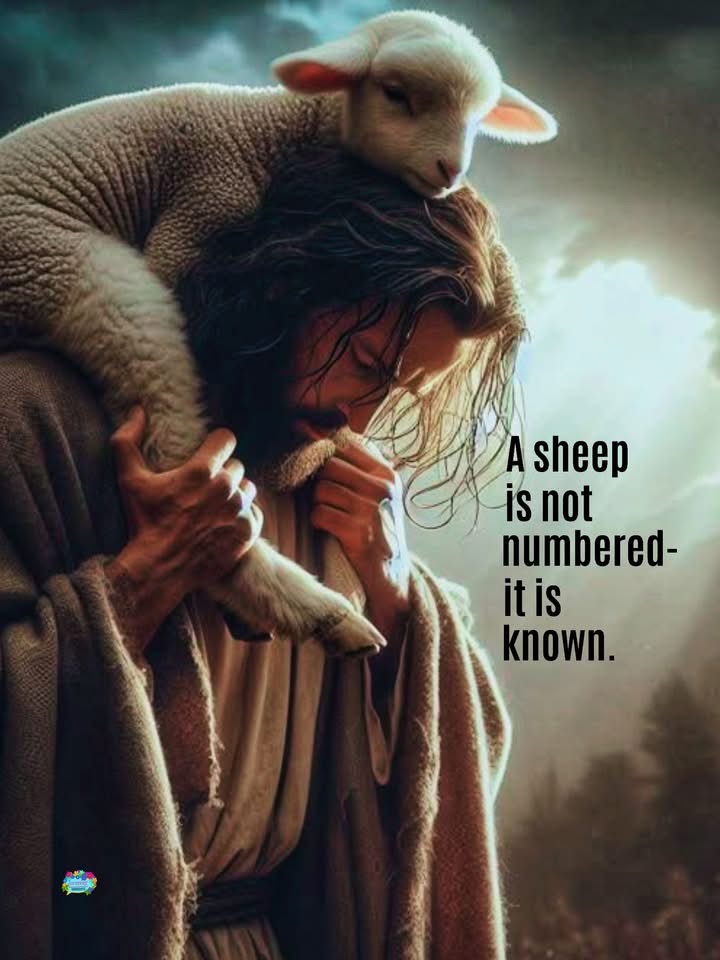
Ein Schaf wird nicht gezählt – es wird erkannt.
Diese Parabel offenbart das Herz Gottes:
Er gibt das eine nicht auf
Er ersetzt das Verlorene nicht
Er sagt nicht: „Wenigstens habe ich noch neunundneunzig“
Er sucht, bis er es findet.
Und wenn er es findet, schimpft er nicht mit ihm.
Er schlägt es nicht.
Er schleppt es nicht nach Hause.
Die Bibel sagt, dass er es voller Freude auf seine Schultern nimmt.
Das ist Gnade.
Warum kein anderes Tier?
Jesus wählte nicht:
Einen Löwen (zu stark)
Einen Fuchs (zu schlau)
ein Pferd (zu unabhängig)
einen Hund (zu eigenwillig)
Er wählte ein Schaf, weil:
Schafe Führung brauchen
Schafe Schutz brauchen
Schafe Rettung brauchen
Schafe Beziehung brauchen
Und vor allem gehören Schafe zu einem Hirten.
Der Hirte, der zum Lamm wurde
Lasst uns zum Schluss diese kraftvolle Wahrheit im Gedächtnis behalten:
Der Hirte, der nach dem verlorenen Schaf sucht
wurde zum Lamm, das für die Schafe geschlachtet wurde.
Jesus hat nicht nur nach uns gesucht.
Er hat sein Leben für uns gegeben.
Ob Sie sich nun fühlen wie:
Verloren
Schwach
Treibend
Unwürdig
Seien Sie getrost.
Sie sind nicht vergessen.
Sie sind nicht entbehrlich.
Sie sind nicht unerreichbar.
Sie sind ein Schaf – und Sie haben einen Hirten.
This entry was posted in Fundstücke, Gemeinsam die Bibel in einem Jahr lesen, Johannes, Lukas, Psalm and tagged Lukas 15 by Jule with 1 commentComments
Schreibe einen Kommentar
Du musst angemeldet sein, um einen Kommentar abzugeben.
WHY A SHEEP?
Key Text: Luke 15:3–7
Jesus said, “Which of you, having a hundred sheep, if he loses one of them, does not leave the ninety-nine in the wilderness and go after the one which is lost until he finds it?”
Have you ever asked yourself: Why did Jesus choose a sheep?
Why not a lion, a horse, a dog, or even a bird?
Why, when describing lost humanity, did Jesus say, “You are like a sheep”?
Jesus never chose illustrations by accident. Every detail in His parables carries truth. Let us discover why the lost is compared to a sheep—and what that reveals about us, about sin, and about God’s heart.
Sheep Get Lost Easily
Unlike many animals, sheep are not natural navigators.
They do not have sharp instincts for direction.
A sheep can wander off simply by nibbling grass—step by step—until it suddenly realizes it is far from the flock.
Isn’t that exactly how people get lost spiritually?
Very few people plan to walk away from God.
No one wakes up one morning and says, “Today, I will ruin my life.”
Instead, it happens slowly:
One neglected prayer
One compromised decision
One unchecked habit
One ignored conviction
Isaiah 53:6 says,
“All we like sheep have gone astray; we have turned, every one, to his own way.”
Jesus did not say, “All we like wolves rebelled,” or “like lions attacked.”
He said, “like sheep”—because we drift before we rebel.
Sheep Cannot Find Their Way Back Alone
Here is something important:
A lost sheep does not become found by itself.
A dog may find its way home.
A bird can fly back to its nest.
A cat often returns on its own.
But a sheep?
Once lost, it becomes more lost.
Spiritually, this is deeply true.
No amount of:
Intelligence
Education
Good intentions
Religious activity
can save a lost soul without the Shepherd.
Jesus said in John 14:6,
“I am the way.”
He did not say, “You will eventually find the way.”
He said, “I am the way.”
This parable teaches us that salvation is not self-rescue.
It is divine pursuit.
Sheep Are Defenseless and Vulnerable
Sheep have:
No sharp claws
No strong teeth
No speed to escape predators
A lost sheep is in constant danger.
Likewise, a soul separated from God is exposed:
To deception
To temptation
To discouragement
To destruction
The enemy is described as a roaring lion, but we are never described as lions.
We are described as sheep.
Without Christ, we are not powerful—we are vulnerable.
That is why David could say in Psalm 23,
“The Lord is my Shepherd; I shall not want.”
A sheep’s safety is not in its strength, but in its Shepherd.
Sheep Recognize the Shepherd’s Voice
Jesus said in John 10:27,
“My sheep hear My voice, and I know them, and they follow Me.”
Even when lost, a sheep can still respond to the Shepherd’s call.
This is a message of hope.
A person may be:
Far from church
Broken by sin
Confused by life
Wounded by failure
But if they are still listening for God, they are not beyond saving.
Jesus did not compare the lost to a wild animal that must be tamed,
but to a sheep that must be called, carried, and restored.
Sheep Are Valuable to the Shepherd
Why would a shepherd leave ninety-nine to search for one?
Because to the shepherd, one sheep matters.
A sheep is not numbered—it is known.
This parable reveals the heart of God:
He does not give up on the one
He does not replace the lost
He does not say, “At least I still have ninety-nine”
He searches until He finds it.
And when He finds it, He does not scold it.
He does not beat it.
He does not drag it home.
The Bible says He puts it on His shoulders, rejoicing.
This is grace.
Why Not Another Animal?
Jesus did not choose:
A lion (too strong)
A fox (too clever)
A horse (too independent)
A dog (too self-directed)
He chose a sheep because:
Sheep need guidance
Sheep need protection
Sheep need rescue
Sheep need relationship
And most of all, sheep belong to a shepherd.
The Shepherd Who Became the Lamb
Finally, let us remember this powerful truth:
The Shepherd who searches for the lost sheep
became the Lamb who was slain for the sheep.
Jesus did not just look for us.
He laid down His life for us.
So, whether you feel:
Lost
Weak
Drifting
Unworthy
Take heart.
You are not forgotten.
You are not disposable.
You are not beyond reach.
You are a sheep—and you have a Shepherd.
(Note: Generated with assistance from ChatGPT)