Jesus wird auf dieselbe Weise und am selben Ort wiederkommen
Messias Jeschua ist nicht einfach „irgendwo in der Nähe von Jerusalem“ in den Himmel aufgefahren.
Er ist von einem ganz bestimmten Ort aus aufgefahren – dem Ölberg.
Und als die Engel in Apostelgeschichte 1 zu den Jüngern sprachen, sagten sie nicht, dass er spirituell, symbolisch oder metaphorisch zurückkehren würde. Sie sagten, er würde auf dieselbe Weise zurückkommen, wie er gegangen war.
Auf dieselbe Weise.
An denselben Ort.
Das allein sollte dich schon zum Nachdenken bringen.
Aber lass uns jetzt noch tiefer gehen.
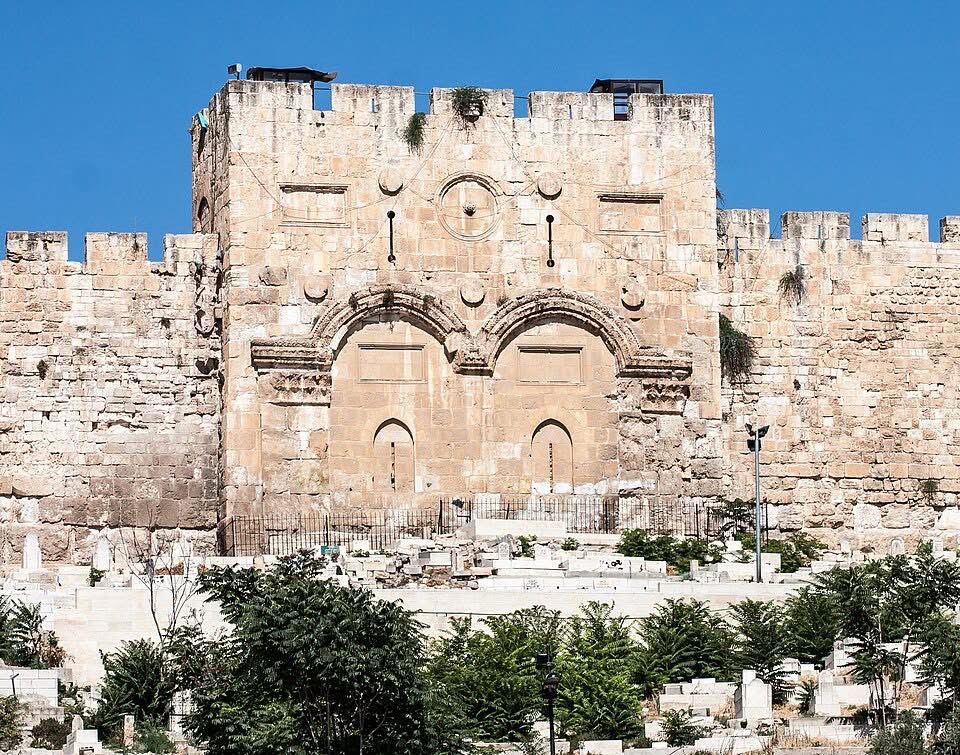
Der Ölberg liegt direkt östlich des Tempelbergs. Wenn du auf dem Ölberg stehst und nach Westen schaust, siehst du direkt auf die Ostmauer Jerusalems – und ein echt seltsames Merkmal daran.
Das Osttor.
Auch Goldenes Tor genannt.
Und hier wird es spannend.
Seit Tausenden von Jahren sagen jüdische Leser von Hesekiel: „Diese Passage? Das ist messianisch.“ Nicht poetisch. Nicht allegorisch. Wörtlich.
Hesekiel beschreibt ein Tor auf der Ostseite des Tempels, das verschlossen ist, und der Grund dafür ist, dass der Herr, der Gott Israels, durch dieses Tor eingetreten ist. Die Sprache ist so geschrieben, als wäre es schon passiert – aber das ist ein klassischer prophetischer Schachzug: über die Zukunft zu reden, als wäre sie schon passiert.
Jetzt spulen wir in der Geschichte vor.
Dieses Tor ist immer noch da.
Und es ist immer noch mit riesigen Steinen zugemauert.
Warum?
Weil 1517, als die Osmanen Jerusalem eroberten, Sultan Suleiman der Prächtige die Prophezeiungen kannte. Er wusste, dass Juden und Christen glaubten, der Messias würde durch dieses Tor kommen. Also ließ er es absichtlich vermauern, in der Annahme, dass die Prophezeiung niemals in Erfüllung gehen könnte, wenn das Tor versperrt wäre.
Menschliche Logik:
„Versiegle das Tor. Halte die Zukunft auf.“
Aber die Heilige Schrift hatte das bereits berücksichtigt.
Denn ein anderer Prophet – Sacharja – spricht nicht nur von einem Tor.
Er spricht vom Berg selbst.
Sacharja sagt, dass der Herr, wenn er kommt, mit seinen Füßen auf dem Ölberg stehen wird, und wenn das passiert, wird sich der Berg von Osten nach Westen in zwei Teile spalten und ein riesiges Tal bilden. Eine Hälfte bewegt sich nach Norden. Die andere bewegt sich nach Süden.
Lies das noch einmal.
Von Osten nach Westen.
Mit Blick auf Jerusalem.
Ein Tal entsteht.
Jetzt kommt der Teil, der fast unwirklich erscheint.
Im 20. Jahrhundert gab es Pläne, auf dem Ölberg zu bauen. Vor dem Bau mussten geologische Untersuchungen gemacht werden. Als Ingenieure den Berg untersuchten, entdeckten sie etwas, das kein Prophet aus der Antike mit menschlichen Mitteln hätte wissen können.
Direkt unter dem Ölberg verläuft eine große Verwerfungslinie.
Ihre Richtung?
Von Osten nach Westen.
Und sie verläuft direkt zum Osttor.
Lass das auf dich wirken.
Der Berg, von dem Zacharias sagte, dass er sich spalten würde, hat bereits eine Verwerfungslinie in genau der beschriebenen Ausrichtung. Wenn sich dieser Berg verschieben würde, würden die versiegelten Steine des Osttors nicht stehen bleiben. Sie würden nach unten stürzen – in das Tal, das durch die Spaltung entstanden ist.
Das bedeutet, dass keine menschlichen Bemühungen, die Prophezeiung zu „blockieren”, etwas ausmachen würden.
Die Schrift sagt auch, dass am Tag des Herrn der Himmel und die Erde erschüttert werden.
Stell dir also Folgendes vor:
Der Messias kommt.
Der Berg reagiert.
Die Erde selbst gehorcht.
Und jeder Stein, der aus menschlicher Angst gesetzt wurde, fällt weg.
Das Tor, das die Erlösung aufhalten sollte, wird irrelevant.
Das ist nicht Symbolik über Symbolik.
Das ist Geografie.
Architektur.
Prophezeiung.
Geschichte.
Geologie.
Alles läuft auf einen Berg zusammen.
Ein Tor.
Ein Moment.
Du kannst heute auf diesem Berg stehen. Du kannst dieses Tor mit eigenen Augen sehen. Und egal, ob du dich dem als Gläubiger, Skeptiker oder Geschichtsstudent näherst, die Konvergenz ist unmöglich zu ignorieren.
Der Ölberg ist noch nicht fertig.
Und in der Geschichte, die die Schrift darüber erzählt, geht es nie darum, ob Gott sein Wort erfüllen kann –
sondern nur darum, ob die Menschheit bereit ist, wenn er es tut.
This entry was posted in Apostelgeschichte, Fundstücke and tagged Apostelgeschichte 1, Jesu Wiederkunft by Jule with 1 commentComments
Schreibe einen Kommentar
Du musst angemeldet sein, um einen Kommentar abzugeben.
Messiah Yeshua didn’t just ascend into heaven “somewhere near Jerusalem.”
He ascended from a very specific place—the Mount of Olives.
And when the angels spoke to the disciples in Acts 1, they didn’t say He’d return spiritually, symbolically, or metaphorically. They said He would come back the same way He left.
Same manner.
Same location.
That alone should make you pause.
But now let’s go deeper.
The Mount of Olives sits directly east of the Temple Mount. If you stand on the Mount of Olives and look west, you are staring straight at Jerusalem’s eastern wall—and one very strange feature in it.
The Eastern Gate.
Also called the Golden Gate.
And here’s where things get wild.
For thousands of years, Jewish readers of Ezekiel have said, “That passage? That’s Messianic.” Not poetic. Not allegorical. Literal.
Ezekiel describes a gate on the east side of the Temple that is shut, and the reason it is shut is because the Lord, the God of Israel, entered through it. The language is written as if it already happened—but that’s a classic prophetic move: speaking of the future as though it has already occurred.
Now fast-forward to history.
That gate is still there.
And it is still sealed shut with massive stones.
Why?
Because in 1517, when the Ottomans conquered Jerusalem, Sultan Suleiman the Magnificent knew the prophecies. He knew Jews and Christians believed the Messiah would come through that gate. So he bricked it up—intentionally—thinking that if the gate were blocked, the prophecy could never be fulfilled.
Human logic:
“Seal the gate. Stop the future.”
But Scripture had already accounted for that.
Because another prophet—Zechariah—doesn’t just talk about a gate.
He talks about the mountain itself.
Zechariah says that when the Lord comes, His feet will stand on the Mount of Olives, and when that happens, the mountain will split in two from east to west, forming a massive valley. One half moves north. The other moves south.
Read that again.
East to west.
Facing Jerusalem.
Creating a valley.
Now here’s the part that feels almost unreal.
In the 20th century, plans were made to build on the Mount of Olives. Before construction, geological surveys were required. When engineers examined the mountain, they discovered something no ancient prophet could have known by human means.
There is a major fault line running directly under the Mount of Olives.
Its direction?
East to west.
And it runs straight toward the Eastern Gate.
Let that sink in.
The mountain Zechariah said would split already has a fault line in the exact orientation described. If that mountain were to shift, the sealed stones of the Eastern Gate wouldn’t remain standing. They would collapse downward—into the valley formed by the split.
Which means no human effort to “block” the prophecy would matter.
Scripture also says that on the Day of the Lord, the heavens and the earth will be shaken.
So imagine this:
The Messiah descends.
The mountain responds.
The earth itself obeys.
And every stone placed by human fear falls away.
The gate meant to stop redemption becomes irrelevant.
This isn’t symbolism stacked on symbolism.
This is geography.
Architecture.
Prophecy.
History.
Geology.
All converging on one mountain.
One gate.
One moment.
You can stand on that mountain today. You can see that gate with your own eyes. And whether you approach this as a believer, a skeptic, or a student of history, the convergence is impossible to ignore.
The Mount of Olives isn’t finished yet.
And the story Scripture tells about it has never been about whether God can fulfill His word—
Only about whether humanity is ready when He does.
https://www.beneiavraham.com