Lass dich nicht von den Eliabˋs deiner Umgebung entmutigen
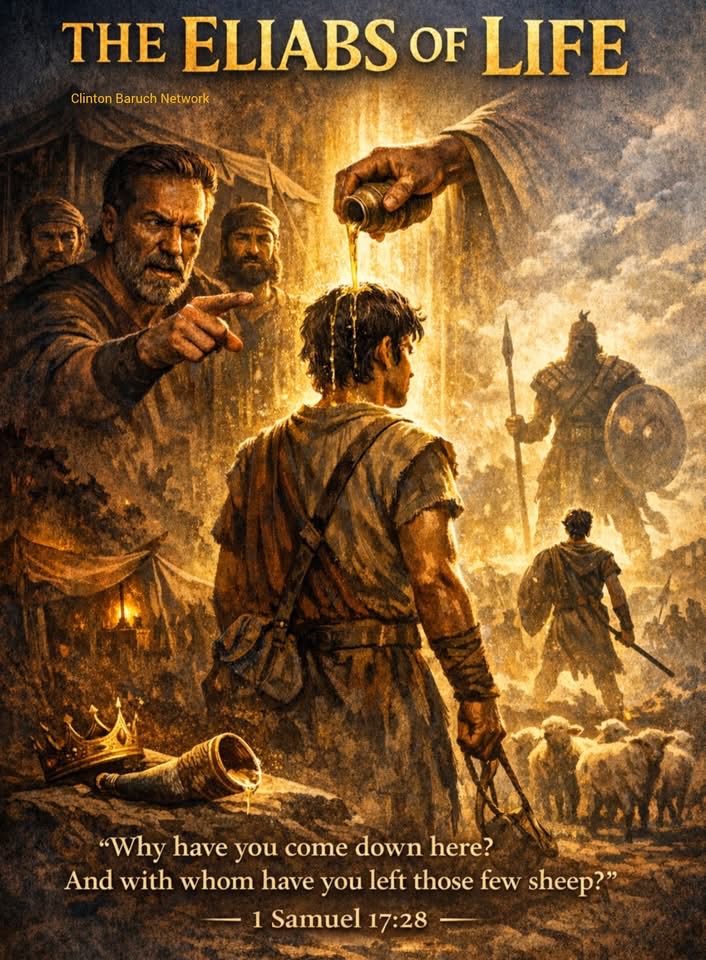
DIE ELIABS DES LEBENS. Es gibt ein Muster, das Sie erkennen müssen, wenn Sie jemals voll und ganz in das hineingehen wollen, wozu Gott Sie berufen hat.
Immer wenn Sie sich Ihrem größten Moment, Ihrer größten Aufgabe, Ihrer entscheidenden Phase nähern, wird sich eine Stimme erheben. Diese Stimme ist nicht immer die eines Fremden. Manchmal ist es ein Familienmitglied. Manchmal ist es jemand, den Sie lieben. Manchmal ist es jemand, den Sie respektieren – jemand, der älter, erfahrener oder sachkundiger ist. Oder es ist die negative, nörgelnde Stimme in Ihrem eigenen Kopf. In der Heiligen Schrift hat diese Stimme einen Namen: Eliab.
Als der Prophet Samuel zu Jesses Haus kam, um einen König zu salben, war Eliab der erste, der erschien. Er sah aus wie jemand, der diese Aufgabe erfüllen konnte. Er hatte die Statur. Er hatte die Ausstrahlung. Sogar Samuel war überzeugt. Aber Gott unterbrach ihn und sagte etwas Zeitloses (1. Samuel 16,7): „Sieh nicht auf sein Aussehen und seine stattliche Gestalt … denn der Mensch sieht, was vor Augen ist, der Herr aber sieht das Herz.“
Eliab hatte militärische Erfahrung. Er hatte eine Position. Er hatte Dienstalter. Was er nicht hatte, war die Salbung.
Das ist das Erste, was Sie über die Eliabs dieser Welt verstehen müssen. Sie wissen vielleicht mehr als Sie. Sie haben vielleicht einen längeren Weg zurückgelegt als Sie. Sie haben vielleicht Qualifikationen, die Sie nicht haben. Aber was ihnen fehlt, ist die göttliche Auswahl. Gott hat sie nicht ausgewählt. Er hat Sie ausgewählt.
Stellen Sie sich vor, wie sich das angefühlt haben muss. Die Familie musste dort stehen bleiben, bis David kam, der Vergessene, der Übersehene, derjenige, den sie nicht einmal für würdig gehalten hatten, eingeladen zu werden. In diesem Moment floss durch Gottes göttliche Auswahl das Öl an Eliab vorbei und legte sich auf David. Dieser Moment sorgte für Spannung. Die Salbung legt die Herzen bloß.
Eliabs sind nicht immer böse. Manche sind verletzt. Manche sind frustriert. Manche sind Menschen, die einmal an Gott geglaubt haben und dann nicht gesehen haben, dass es passiert ist. Wenn sie sehen, dass Gott es durch dich tun will, feiern sie nicht, sondern widersetzen sich.
Sie greifen dich nicht offen an. Sie raten dir vorsichtig. Sie raten dir, klein zu bleiben, vorsichtig zu sein, nicht zu viel zu versuchen und dort zu bleiben, wo du bist.
Schnellvorlauf zum Schlachtfeld. David kommt, um Essen zu bringen, und sieht Goliath, der die Armeen des lebendigen Gottes verspottet. Etwas in ihm erwacht. Seine Bestimmung erwacht. Sein Schicksal regt sich. Und ratet mal, wer als Erster spricht? Es war Eliab, der in 1. Samuel 17,28 fragte: „Warum bist du hierher gekommen? Und bei wem hast du die wenigen Schafe gelassen?“
Das ist es, was Eliabs tun. Sie spielen deine Aufgabe herunter. Sie erinnern dich an deine Vergangenheit. Sie reduzieren deine Berufung auf deine Herkunft. Sie hinterfragen deine Motive und bezichtigen deine Leidenschaft. Sie versuchen, dich an dem zweifeln zu lassen, was Gott bereits entschieden hat.
Aber Davids Antwort in 1. Samuel 17,29 sagt alles: „Gibt es denn keinen Grund?“
Keine Argumente. Keine Verteidigung. Keine Erklärung. Keine Notwendigkeit für Bestätigung.
Pass auf, mein Freund. Es kommt eine Zeit, in der du aufhören musst, dich Menschen zu erklären, die niemals verstehen werden, welche Last Gott dir auf das Herz gelegt hat. Es kommt eine Zeit, in der du dich von Stimmen abwenden musst, die weise klingen, aber in Angst, Eifersucht oder verpassten Chancen verwurzelt sind.
David hat Eliab nicht besiegt. Er hat ihn ignoriert.
So gewinnt man. Dein Kampf ist nicht gegen Eliab, dein Kampf ist gegen Goliath. Eliab wird immer versuchen, dich abzulenken, bevor du dich deinem Riesen stellst. Wenn sie dich mit Worten aufhalten können, brauchen sie keine Waffen.
Lass dir von niemandem ausreden, was Gott dir bereits gesagt hat. Du bist vielleicht jung. Du wirst vielleicht unterschätzt. Du wirst vielleicht übersehen. Aber du bist gesalbt. Und Öl lügt nicht.
Gott beeindruckt nicht allein die Erfahrung. Er lässt sich von Gehorsam, Glauben und deinem Herzen bewegen.
Deshalb sage ich dir heute: Hör auf, dich klein zu machen, hör auf, dich zu entschuldigen, hör auf, dich zu rechtfertigen. Wenn Gott die Tür öffnet, geh durch sie hindurch. Wenn Gott dein Herz bewegt, handle. Wenn Eliab spricht, denk daran, wer dich gesalbt hat. Dein Leben ist kein Fehler. Deine Berufung ist keine Arroganz. Dein Hunger ist keine Rebellion.
Es gibt einen Grund. Und du wurdest dafür auserwählt.
Und denk daran: Während du die entmutigende Stimme Eliabs ignorieren musst, wird Gott dir auf deiner Reise auch strategische Stimmen wie die des Propheten Nathan schicken, Stimmen, die dich in Liebe und nicht aus Angst auf den richtigen Weg bringen. Möge Gott dir die Weisheit geben, den Unterschied zu erkennen.
Amen.
This entry was posted in 1. Samuel, Ermunterung, Fundstücke, Gemeinsam Bibellesen and tagged 1. Samuel 17, David, Eliab, Entmutigung by Jule with 1 commentComments
Schreibe einen Kommentar
Du musst angemeldet sein, um einen Kommentar abzugeben.
THE ELIABS OF LIFE. There is a pattern you must recognize if you are ever going to step fully into what God has called you to do.
Whenever you are close to your biggest moment, your greatest assignment, your defining season, a voice will rise. That voice is not always a stranger. Sometimes it is family. Sometimes it is someone you love. Sometimes it is someone you respect—someone older, more experienced, or more knowledgeable. Or, it is the negative, nagging voice in your own head. In the scripture, that voice has a name: Eliab.
When the prophet Samuel came to Jesse’s house to anoint a king, Eliab was the first to appear. He looked the part. He had the stature. He had the presence. Even Samuel was convinced. But God interrupted him and said something timeless (1 Samuel 16:7): “Do not look at his appearance or at the height of his stature… for man looks at the outward appearance, but the Lord looks at the heart.”
Eliab had military experience. He had a position. He had seniority. What he did not have was the anointing.
That is the first thing you must understand about the Eliabs of this world. They may know more than you. They may have walked longer than you. They may have credentials you don’t have. But what they lack is the divine selection. God did not choose them. He chose you.
Imagine how it must have felt. The family had to stand there until David arrived, the forgotten one, the overlooked one, the one they didn’t even consider worthy of an invitation. In that moment, by God’s divine selection, the oil flowed past Eliab and settled on David. That moment created tension. Anointing exposes hearts.
Eliabs are not always evil. Some are wounded. Some are frustrated. Some are people who once believed God for something and didn’t see it happen. When they see God about to do it through you, instead of celebrating, they resist.
They don’t attack you openly. They advise cautiously. They counsel you to stay small, to be careful, not try too much, and to remain where you are.
Fast forward to the battlefield. David arrives to deliver food and sees Goliath mocking the armies of the living God. Something in him rises. Purpose awakens. Destiny stirs. And guess who speaks first? It was Eliab, who demanded in 1 Samuel 17:28, “Why have you come down here? And with whom have you left those few sheep?”
That is what Eliabs do. They minimize your assignment. They remind you of your past. They reduce your calling to where you came from. They question your motives and accuse your passion. They try to make you doubt what God has already settled.
But David’s response in 1 Samuel 17:29 is everything: “Is there not a cause?”
No argument. No defense. No explanation. No need for validation.
Pay attention, friend. There comes a time when you must stop explaining yourself to people who will never understand the burden God placed in your heart. There comes a time when you must walk away from voices that sound wise but are rooted in fear, jealousy, or missed opportunity.
David did not defeat Eliab. He ignored him.
That is how you win. Your battle is not with Eliab; your battle is with Goliath. Eliab will always try to distract you before you face your giant. If they can stop you with words, they won’t need weapons.
Do not let anyone talk you out of what God has already talked you into. You may be young. You may be underestimated. You may be overlooked. But you are anointed. And oil does not lie.
God is not impressed by experience alone. He is moved by obedience, faith, and the state of your heart.
So today, I say to you: stop shrinking, stop apologizing, stop explaining. When God opens the door, walk through it. When God stirs your heart, move. When Eliab speaks, remember who anointed you. Your life is not a mistake. Your calling is not arrogance. Your hunger is not rebellion.
There is a cause. And you were chosen for it.
And remember this: while you must ignore the discouraging voice of Eliab, in your journey God will also send strategic voices like the prophet Nathan, voices that course-correct in love, not from fear. May God grant you the wisdom to discern the difference.
Amen.
Clinton Baruch Network