Saul und der Heilige Geist
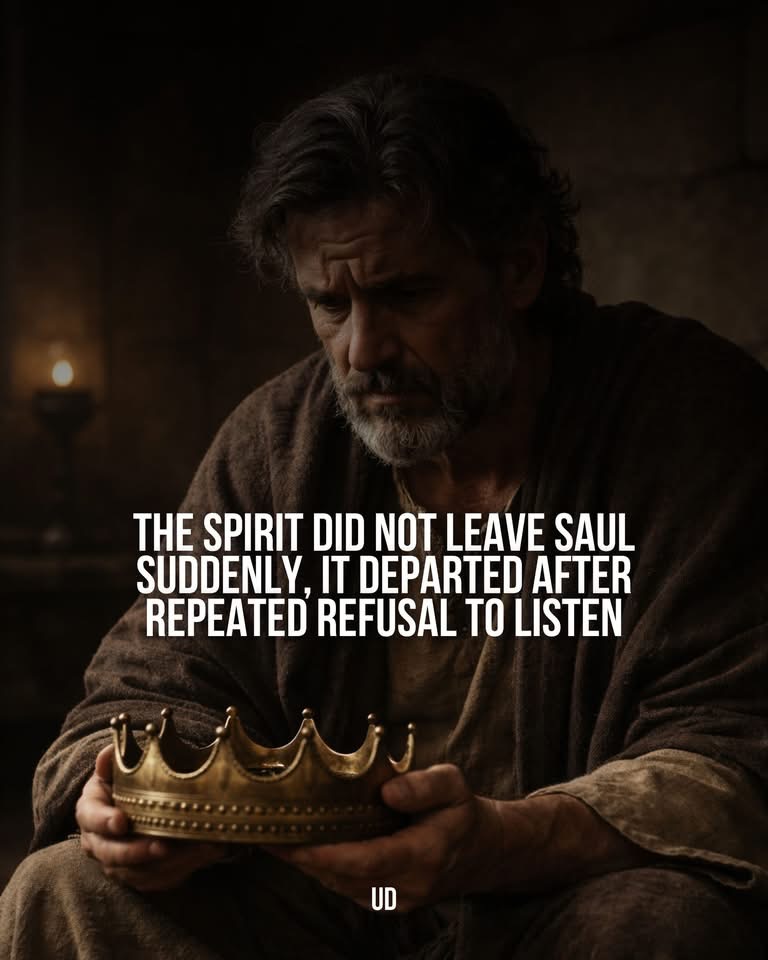
Saul wurde in der Geschichte Israels nicht als Bösewicht vorgestellt, sondern vielmehr als Antwort auf Gebete.
Er wurde zu einer Zeit ausgewählt, als das Volk
Israel sich nach Stabilität, Sicherheit
und einem sichtbaren Anführer „wie die anderen Völker“ sehnte.
Nun, er sah dafür geeignet aus.
Er war groß, beeindruckend und äußerlich für das Königtum geeignet.
Die Schrift sagt uns sogar, dass er, als er zum ersten Mal vorgestellt wurde,
auf der Suche nach verlorenen Eseln war und nicht nach Macht.
Er zeigte früh Demut und eine
Zögerlichkeit, die fast bewundernswert wirkte
(1. Samuel 9–10).
Aber Sauls Tragödie besteht nicht darin, dass er schlecht angefangen hat.
Sondern dass er gut begann und langsam aufhörte, auf Gott zu hören.
Der Wendepunkt in Sauls Leben war nicht eine einzelne dramatische Sünde,
sondern ein Muster von teilweisem Gehorsam.
Als der Prophet Samuel ihm auftrug
auf das Wort des Herrn zu warten, wartete Saul,
aber nicht lange genug.
Er brachte das Opfer selbst dar und erklärte, dass das Volk
sich zerstreute und die Situation dringend sei.
Seine Argumentation klang praktisch, sogar verantwortungsbewusst.
Aber sie offenbarte etwas Tieferes: Saul hatte begonnen,
mehr auf Druck als auf Anweisungen zu vertrauen
und mehr auf Dringlichkeit als auf Gehorsam.
Von da an vertiefte sich dieses Muster.
Bei dem Befehl gegen Amalek
gehorchte Saul nur selektiv.
Er verschonte, was nützlich erschien, behielt, was dem Volk gefiel,
und verteidigte dann sein Handeln mit spiritueller Sprache.
„Ich habe den Befehl des Herrn ausgeführt“,
sagte er, während er neben seiner Ungehorsamkeit stand.
Samuels Antwort ist immer noch still, aber bestimmt
„Gehorsam ist besser als Opfer.“
Wenn man dies betrachtet, hat Saul Gott nicht rundweg abgelehnt.
Er definierte Gehorsam neu, um ihn seiner Angst vor den Menschen
und seinem Wunsch, die Kontrolle zu behalten, anzupassen.
An dieser Stelle wird Sauls Geschichte unangenehm nachvollziehbar.
Sauls Untergang hatte seine Wurzeln nicht
im Atheismus oder in Rebellion, sondern in Unsicherheit.
Saul fürchtete, das Volk zu verlieren.
Er fürchtete, an Bedeutung zu verlieren.
Er fürchtete, seine Position zu verlieren.
Mit der Zeit veränderte diese Angst seine Führungsqualitäten.
Als Gottes Gegenwart unsicher wurde,
griff Saul noch stärker nach der Kontrolle.
Als David auftauchte, tat Saul nicht Buße, sondern konkurrierte mit ihm.
Die Salbung, die einst auf ihm ruhte, wurde zu etwas,
das er zu schützen versuchte, anstatt sich ihm hinzugeben.
Die tragischste Zeile in Sauls Leben
wird nicht von ihm gesprochen, sondern über ihn
„Der Geist des Herrn wich von Saul“
(1. Samuel 16,14).
Dies geschah nicht plötzlich und überraschend.
Es folgte auf wiederholte Momente, in denen Saul
das Äußere über die Ausrichtung und den Ruf über die Reue stellte.
Er wollte Gottes Vorteile ohne Gottes Autorität.
Am Ende seines Lebens stand Saul als König da,
der zwar noch die Krone trug,
aber nicht mehr mit dem Herrn wandelte.
Er suchte Führung nicht bei Gott,
sondern bei verbotenen Quellen.
Der Mann, der sich einst in Demut versteckte,
jagte nun David in seiner Paranoia.
Sauls Leben warnt uns, dass die Nähe zu Gottes Werk
nicht dasselbe ist wie die Unterwerfung unter Gottes Stimme.
Und doch ist Sauls Geschichte nicht nur geschrieben, um ihn zu verurteilen.
Sie ist geschrieben, um etwas in uns aufzudecken.
Saul zeigt uns, welche Art von König die Menschheit von Natur aus hervorbringt:
einen, der mit Versprechungen beginnt, aber
unter dem Gewicht der Selbsterhaltung zusammenbricht.
Er offenbart, wie Führung ohne Hingabe
zerstörerisch wird und wie Religion
ohne Gehorsam hohl wird.
Saul war genau die Art von König, die Israel sich gewünscht hatte.
Und genau das ist das Problem.
Sein Leben weckt eine Sehnsucht.
Denn wenn Saul das Beste war, was die Menschheit zu bieten hatte,
stark, beeindruckend, religiös, dann brauchte Israel eine andere Art von König.
Diese Sehnsucht ist der Punkt, an dem Christus in die Geschichte eintritt.
Jesus ähnelte Saul in keiner Weise.
Nach weltlichen Maßstäben sah er nicht beeindruckend aus.
Er klammerte sich nicht an die Macht und fürchtete nicht, Anhänger zu verlieren.
Wo Saul in Panik Opfer brachte,
gehorchte Jesus dem Vater im Vertrauen.
Wo Saul nach der Königswürde griff,
legte Jesus seine nieder.
Und wo Saul durch Ungehorsam den Geist verlor,
lebte Jesus in vollkommener Einheit mit dem Vater
und goss den Geist frei aus.
Sauls Königreich endete in Angst und Isolation.
Das Reich Christi begann am Kreuz.
Saul zeigt uns, dass ein König, der sich selbst rettet,
sein Volk nicht retten kann.
Christus zeigt uns, dass ein König, der sich selbst hingibt,
die Welt retten kann.
Sauls Leben warnt uns davor, wohin ungebremste Unsicherheit führt.
Jesus lädt uns zu der Ruhe ein, die Saul nie gefunden hat.
Und in diesem Gegensatz findet die Geschichte von Saul endlich ihre Bedeutung,
nicht als ein Versager, den wir verspotten, sondern als ein Spiegel, den wir brauchen,
der uns auf den einzigen König hinweist, der nie
aufgehört hat, auf den Vater zu hören.
This entry was posted in 1. Samuel, Fundstücke, Gemeinsam Bibellesen and tagged 1. Samuel 10, 1. Samuel 16, 1. Samuel 9 by Jule with 1 commentComments
Schreibe einen Kommentar
Du musst angemeldet sein, um einen Kommentar abzugeben.
Saul was introduced in Israel’s story not as a villain, but in fact, as an answer to prayer.
He was chosen at a moment when the people
of Israel was longing for stability, security,
and a visible leader “like the nations.”
Well, he looked the part.
He was tall, impressive, externally fit for kingship.
Scripture even tells us that when he was first introduced,
he was found searching for lost donkeys, not for power.
There was an early humility in him and there was
a hesitation that almost felt admirable
(1 Samuel 9–10).
But Saul’s tragedy is not that he began badly.
It is that he began well, and slowly stopped listening to God.
The turning point of Saul’s life was not a single dramatic sin,
but a pattern of partial obedience.
When the prophet Samuel instructed him
to wait for the word of the Lord, Saul waited,
but not long enough.
He offered the sacrifice himself, explaining that the people
were scattering and the situation felt urgent.
His reasoning sounded practical, even responsible.
But it revealed something deeper, Saul had begun
to trust pressure more than instruction,
and urgency more than obedience.
From there, the pattern deepened.
In the command against Amalek,
Saul obeyed selectively.
He spared what looked useful, he kept what pleased the people,
and then defended his actions with spiritual language.
“I have carried out the Lord’s command,”
he said, while standing beside disobedience.
Samuel’s response still cuts quietly but firmly,
“To obey is better than sacrifice.”
Looking into this, Saul did not reject God outright.
He redefined obedience to fit his fear of people
and his desire to maintain control.
That is where Saul’s story becomes uncomfortably relatable.
Saul’s downfall was not rooted
in atheism or rebellion, but in insecurity.
Saul feared losing the people.
He feared losing relevance.
He feared losing position.
Over time, that fear reshaped his leadership.
When God’s presence felt uncertain,
Saul grasped harder for control.
When David emerged, Saul did not repent, he competed.
The anointing that once rested on him became something
he tried to protect rather than surrender.
The most tragic line in Saul’s life
is not spoken by him, but about him,
“The Spirit of the Lord departed from Saul”
(1 Samuel 16:14).
This did not happen suddenly as a surprise.
It followed repeated moments where Saul chose
appearance over alignment and reputation over repentance.
He wanted God’s benefits without God’s authority.
By the end of his life, Saul stood as a king
who was still wearing the crown,
but no longer walking with the Lord.
He sought guidance not from God,
but from forbidden sources.
The man who once hid in humility
now hunted David in paranoia.
Saul’s life warns us that proximity to God’s work
is not the same as submission to God’s voice.
And yet, Saul’s story is not written merely to condemn him.
It is written to expose something in us.
Saul shows us what kind of king humanity naturally produces,
one who starts with promise, but collapses
under the weight of self-preservation.
He reveals how leadership without surrender
turns destructive, and how religion
without obedience becomes hollow.
Saul was exactly the kind of king Israel asked for.
And that is precisely the problem.
His life creates a longing.
Because if Saul was the best humanity could offer,
strong, impressive, religious, then Israel needed a different kind of king.
That longing is where Christ enters the story.
Jesus did not resemble Saul in any way.
He did not look impressive by worldly standards.
He did not cling to power or fear losing followers.
Where Saul offered sacrifice in panic,
Jesus obeyed the Father in trust.
Where Saul grasped at kingship,
Jesus laid His down.
And where Saul lost the Spirit through disobedience,
Jesus lived in perfect union with the Father
and poured the Spirit out freely.
Saul’s kingdom ended in fear and isolation.
Christ’s kingdom began at the cross.
Saul shows us that a king who saves himself
cannot save his people.
Christ shows us that a King who gives Himself
can save the world.
Saul’s life warns us where unchecked insecurity leads.
Jesus invites us into the rest that Saul never found.
And in that contrast, the story of Saul finally finds its meaning,
not as a failure we mock, but as a mirror we need,
pointing us to the only King who never
stopped listening to the Father.